RCS provisioning at operator scale

Messaging & Entitlement RCS Provisioning

The provisioning layer that decides whether a subscriber’s device becomes an RCS device. It handles capability discovery and configuration at operator scale, and — unusually for this part of the stack — it tells you what is actually happening while it does it.

  • GSMA RCS Universal Profile client configuration and capability exchange
  • Handles the provisioning storm that follows any RCS launch or OS update
  • Works with Google Jibe, an on-net RCS stack, or both during migration
  • Per-tenant policy and branding for MVNE deployments
  • Full observability: success, latency and failure mode per device model and OS version

RCS Universal Profile

Capability discovery

Auto-configuration

Google Jibe

On-net RCS

TS.43 handover

Per-device policy

Multi-tenant

Kubernetes

PX instrumented

Where RCS rollouts actually go wrong

Not in the chat. In provisioning. An OS update ships, several million devices re-request configuration inside an hour, the provisioning path saturates, and a proportion of handsets fall back to SMS and stay there until something forces a retry.

The subscriber sees no error. Your dashboards see no outage. RCS adoption quietly plateaus and nobody can explain why.

This component is built for that load profile, and it is instrumented so that the plateau is visible as a number: provisioning success per device model, per OS version, per hour, with the failing exchange available as a trace rather than a hypothesis.

Capabilities

Configuration at scale

Burst-tolerant auto-configuration with rate shaping and backoff policy, sized for OS-update storms rather than steady state.

Capability discovery

Presence and capability exchange, with caching policy tuned so that discovery traffic does not become its own incident.

Migration-friendly

Run Jibe and an on-net stack simultaneously, split by device class or subscriber segment, and move the split without a maintenance window.

Observability built in

Every provisioning exchange scored. Adoption becomes a measurement instead of a quarterly guess.

Logical architecture

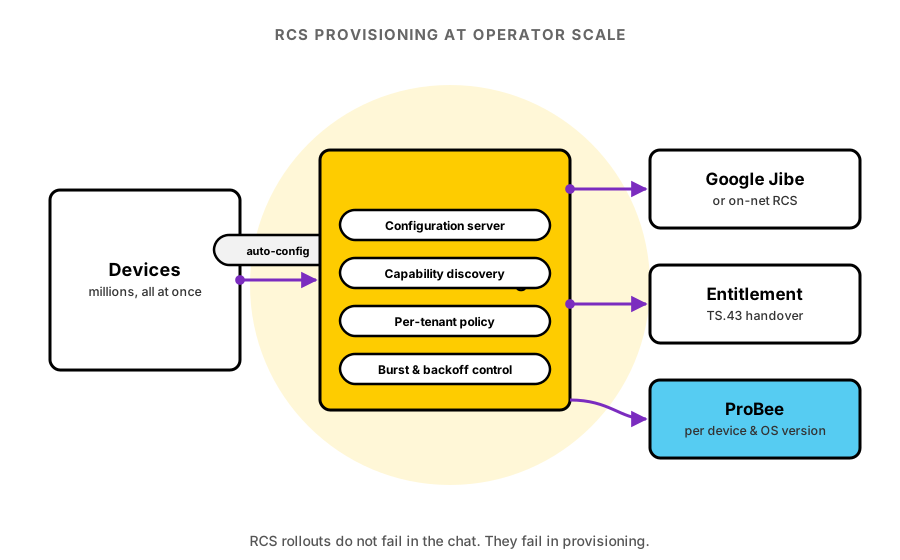
Configuration server. The HTTPS endpoint the RCS client queries, rendering per-device, per-OS and per-tenant configuration.

Capability service. Presence and capability exchange with a cache layer sized for the discovery load RCS generates.

Policy and tenant store. Who may be provisioned, under which brand, with which feature set, sourced from your BSS.

Entitlement handover. Clean separation between TS.43 entitlement and RCS configuration, so the two can be deployed independently or together.

Assurance tap. ProBee instrumentation on every exchange.

RCS Provisioning logical architecture

Planning an RCS launch?

Bring us the provisioning and entitlement half. It is the part that is usually underestimated and it is the part we have already built.